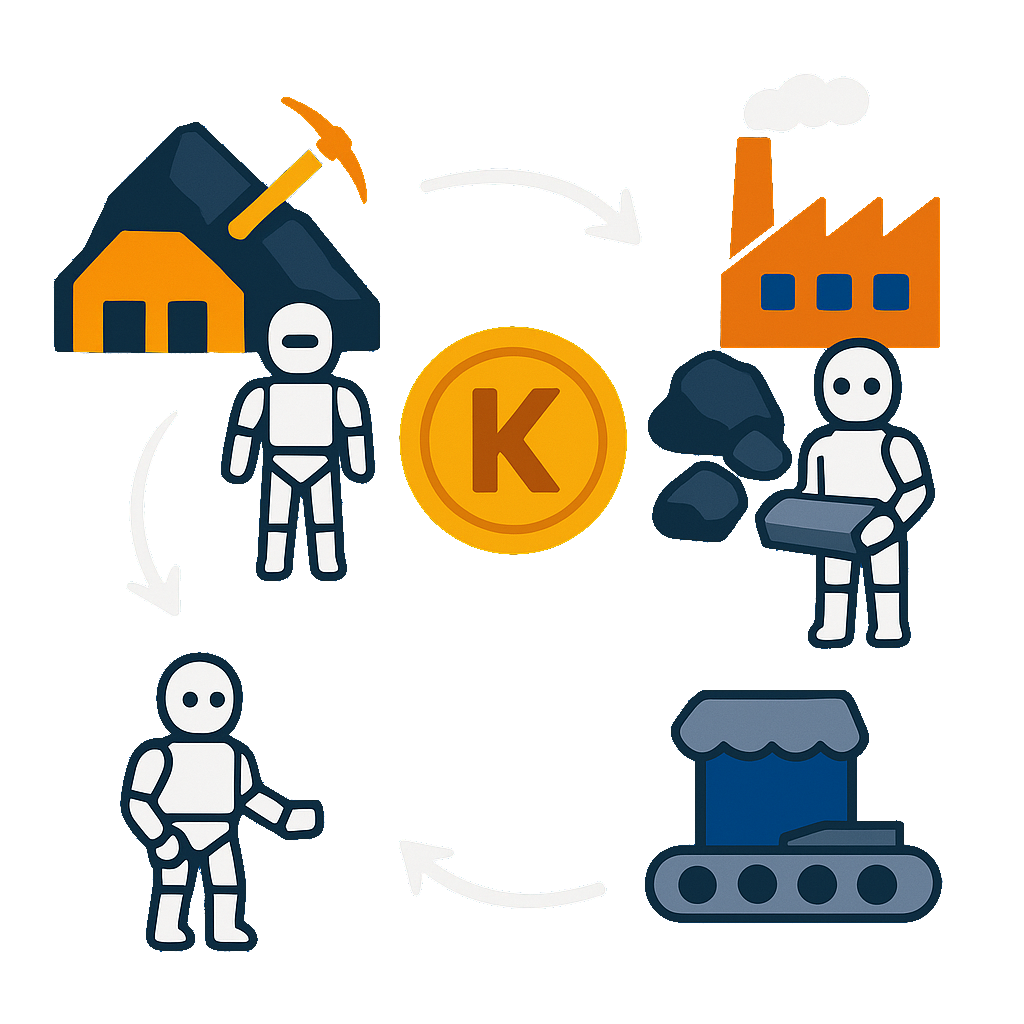
Dive into a world where every decision counts, every resource has value, and economic success depends on your strategy.
Understanding the Economic Foundation of Investycoon
Far more than just a management game, Investycoon is a true virtual economic simulation.
Players create and run their own companies, exploit natural resources, manufacture high-value products, and trade freely on a global market.
The goal? To build a sustainable empire in a living, dynamic economy inspired by real-world economic principles.
Producing to Create Value
At the heart of Investycoon are the virtual companies created by players. Each company is an independent production unit capable of using various technologies — pickaxe, axe, drill, industrial machine, blast furnace, and more.
These technologies allow players to transform raw resources into more complex and profitable products. For example, iron ore becomes ingots, crude oil becomes gasoline, and wood is processed into building materials.
Virtual employees can be added to boost productivity and efficiency.
This is the very essence of added value — the more a product is transformed, the greater its worth on the market.
💡 Just like in the real world, wealth is created through transformation and innovation.
Resources, Products, and the Value Chain
Investycoon's virtual economy is built around a consistent value chain composed of several resource levels:
- Primary resources: wood, coal, iron ore, copper, oil…
- Intermediate products: ingots, plastics…
- Finished goods: materials, components, or manufactured products.
Each transformation step increases a product's value but also requires investment, technology, and good inventory management.
Success depends on finding the right balance between costs, production time, and selling price.
The Market: Between Freedom and Regulation
In Investycoon, the market is a living space where companies freely trade their goods and resources.
There are three main types of transactions:
- Direct contracts 📝 – companies negotiate prices and quantities directly.
- Deferred sales 💼 – the seller sets a price based on current market rates.
- Intermediation via the GSA 🏦 – a central authority that facilitates trade and provides indicative prices.
Prices naturally fluctuate according to supply and demand. When resources become scarce, their value rises — just like on a real commodities exchange.
🔍 This flexibility allows each player to shape their own strategy: speculate, produce efficiently, or focus on high-value niches.
The KET: Engine of the Virtual Economy
The KET (K) — Investycoon's currency — is much more than a simple payment tool; it's the lifeblood of the economy.
Its issuance and regulation are handled by the Investycoon Central Bank.
The KET enters the economy through:
- loans granted to companies and players,
- economic rewards,
- purchases and transactions made on the platform.
This monetary management ensures a healthy balance between growth and stability. Too much money creation could lead to inflation, while too little would restrict trade — exactly as in real-world economies.
📎 Learn more: How the monetary loan system works in Investycoon.
💬 "The KET is to Investycoon what the euro is to the European Union: a pillar of trust and exchange."
Growth, Bankruptcy, and Economic Balance
Investycoon's virtual economy is not static — it evolves according to player decisions. Each company can:
- grow by investing in new technologies,
- borrow funds to speed up development,
- or go bankrupt if poorly managed.
These mechanics introduce a necessary dimension of risk and strategy, essential to any realistic economic system. Even without taxation or wages at this stage, the game already mirrors real-life economic cycles: growth, slowdown, crisis, recovery…
⚙️ Success depends as much on industrial strategy as on expecting market trends.
A Simulation Inspired by the Real World
What makes Investycoon unique is its faithfulness to real economic principles. It incorporates:
- resource scarcity,
- the law of supply and demand,
- value creation through production,
- and the central role of currency.
Every action has consequences for the wider market, creating a complete and interconnected virtual economic ecosystem.
📊 By playing Investycoon, you learn the fundamentals of macroeconomics — often without even realizing it.
Become a Key Player in This Virtual Economy
Investycoon offers far more than a game: it is an interactive economic experience, where market logic, business management, and financial strategy blend into an immersive universe.
💼 It's your turn to produce, negotiate, invest, and thrive.
Build your virtual empire today
Join Investycoon and take control of your business.
Play now →